01 · Machine-learning research
GNN–RL Self-Healing Disaster Routing
I authored the research with Jaspreet Kaur and co-produced the code for a self-healing routing framework designed to keep healthcare wireless sensor networks connected through disaster-induced node failures.
GNN–RL96.0%mean route delivery
LSTM–RL89.6%mean route delivery
100 paired trials · extreme-severity simulation · p = 0.0267
Research question
Can a routing system use network structure and live risk signals to recover paths when a disaster damages relays carrying patient-sensor data?
Model insight
Ablation work exposed a mismatch: binary GNN labels discarded the continuous risk signal used by the RL reward. I moved the final GNN to MSE regression over continuous node risk while retaining graph-aware aggregation.
Evaluation
The 74-node simulator compares six routing strategies across multiple severities, with fixed seed ranges, ablations, statistical testing, and saved reference outputs for reproducibility.
The results are based on simulated networks. Real deployment traces, mobility, hardware energy measurements, and clinical validation remain future work.
02 · Android usability experiment
MD3 Touch Target Methodology
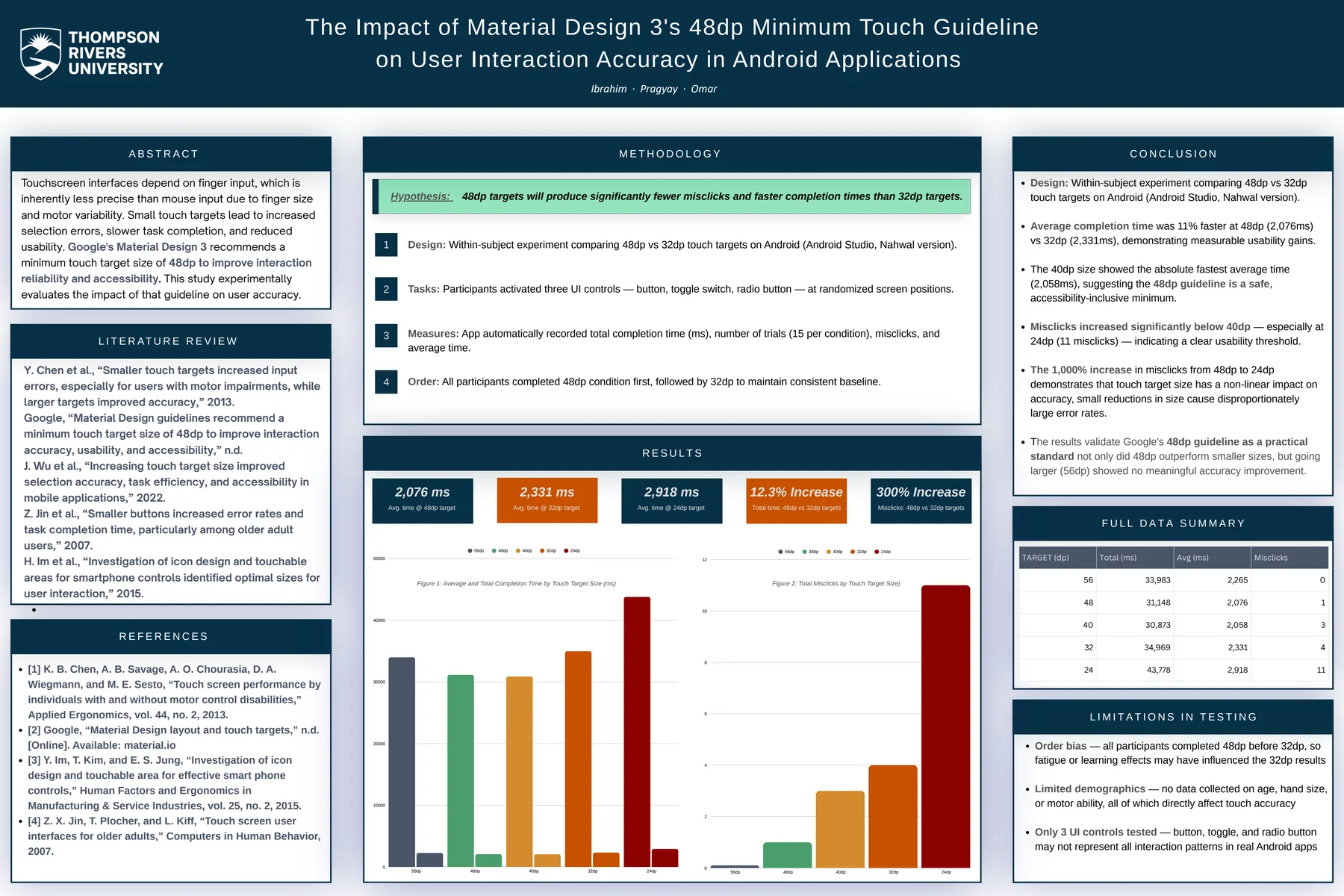
The repository credits me as the project’s original developer. I built the foundation for an Android experiment that studies how interface target size affects task speed and misclick frequency.
Question
How does reducing the size of common controls change completion time and interaction accuracy on a mobile screen?
Method
Buttons, toggles, and radio controls appear at randomized locations across five size conditions while the app records trials, timing, misclicks, and averages.
Contribution
I created the original Android project and experimental foundation; the shared repository documents later extensions, UI improvements, and tracking work by a collaborator.
Research presentation
From Android experiment to conference poster.
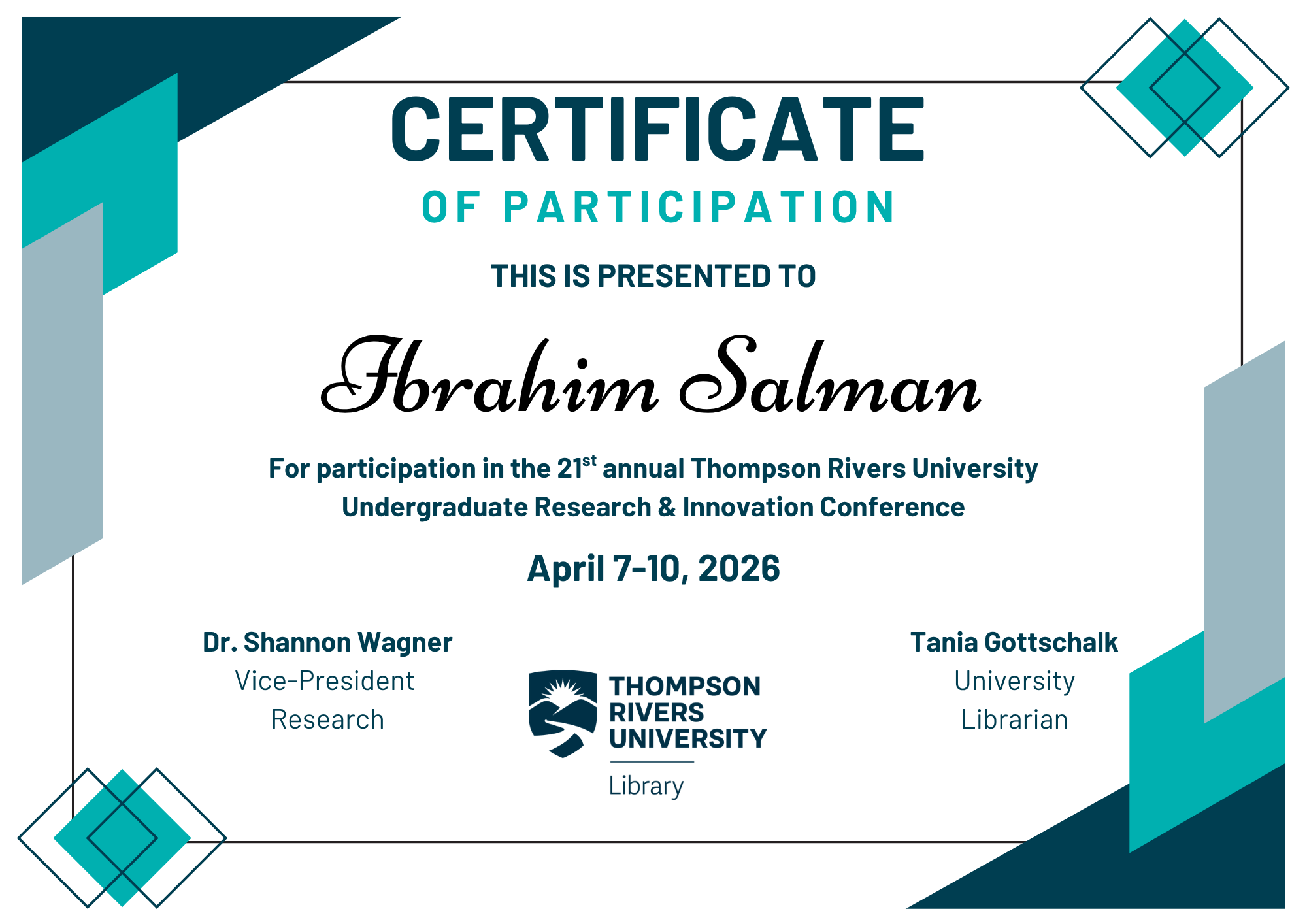
I presented this work with my co-authors at Thompson Rivers University’s 21st Annual Undergraduate Research & Innovation Conference, held April 7–10, 2026. The poster reports the experiment’s full five-size dataset, including a 300% increase in misclicks from 48dp to 32dp and the sharpest error increase at 24dp.
03 · Collaborative Android development
MedReminder
A completed three-person Android term project for medication schedules, dose logging, refill tracking, alarms, and adherence history. My commits span product features, API integration, interface work, and team integration.
Features delivered
I implemented medication functionality and layouts, settings auto-save, light and dark themes, data clearing, emergency contacts, snooze controls, and quiet hours.
Data & integration
I built the barcode-scanning flow with real-time drug-lookup API support plus medication-history logging, a calendar heatmap, and CSV export.
Collaboration
I resolved pull-request and integration errors, merged teammates’ Today-screen and dosage-tracking work, and contributed animations, Material UI refinements, and splash-screen branding.
The repository records these contributions across commits from April 2–16, 2026. The term project concluded later that month.
04 · Front-end development
Kamloops Volleyball Association
A multi-page website concept for players and families who need a clear path to programs, club information, gallery content, and contact details.
Problem
Several audience groups needed different information without making the navigation feel fragmented.
Approach
I separated youth, adult, organization, gallery, and contact content into predictable page groups.
What I learned
Shared navigation and styling must be planned early when a static site grows beyond one page.
05 · Requirements & system design
Retail Resale Management System
A requirements-driven design for inventory, sales, customers, credit, and payments. The project focuses on the thinking that should happen before implementation begins.
Problem
Retail workflows quickly become inconsistent when inventory, payments, credit, and customer records are treated separately.
Approach
I documented the business areas as one connected system and defined their responsibilities before choosing implementation details.
What I learned
Clear requirements reduce ambiguity and make later technical decisions easier to defend.
06 · Personal product
Portfolio website
A lightweight, accessible site that replaces a generic project gallery with a clear story about what I build, how I think, and what I’m learning.
Problem
The earlier version looked polished at first glance but contained placeholders, broken navigation, and unsupported claims.
Approach
I built a coherent visual system around code, rhythm, and personal context while keeping dependencies minimal.
What changed
Every action works, projects are verifiable, navigation is accessible, and content reflects real experience.